
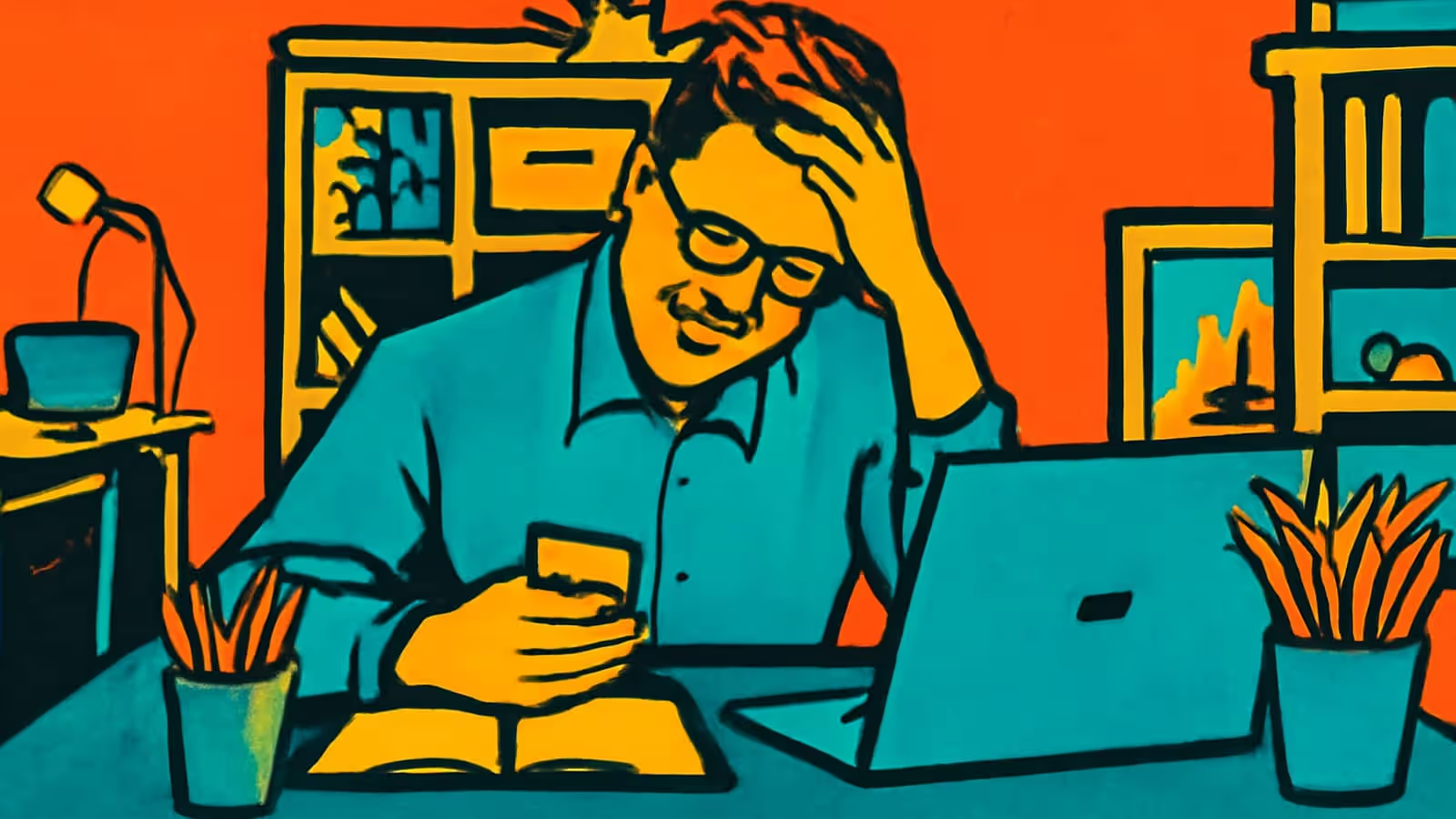
ADHD in adults rarely looks like the picture most people carry around, which is a large part of why it gets missed. The restlessness usually turns inward and becomes a mind that will not settle rather than a body that will not sit still, and the difficulty shows up as unfinished tasks, lost time and a sense of working twice as hard for the same result. This guide covers what adult ADHD actually looks like day to day, why it is so often overlooked, and how it is told apart from anxiety, low mood or plain exhaustion.
The stereotype is doing a lot of damage
Ask most people to picture ADHD and they will describe a boy of about eight who cannot stay in his chair. That image is not wrong, exactly. It is just one presentation, at one age, in one setting, and it has quietly determined who gets recognised and who does not.
If you were the child who finished the reading early and then stared out of the window, or the one whose reports said bright but disorganised, nobody was looking at you. Meta-analytic work puts adult ADHD at roughly 2.5% of the adult population, which is a lot of people to be operating on a mental image drawn from a primary school classroom. [simon-2009-adult-adhd-prevalence]
What it actually looks like at 34
The details that bring people to an assessment are usually mundane rather than dramatic:
Starting is the hard part, not doing. The task takes twenty minutes. It has been on the list for eleven days. This is not laziness and it is not really about willpower; tasks that are neither urgent nor interesting are genuinely harder to begin.
Time behaves strangely. Either five minutes vanished or four hours did. Estimating how long anything will take is consistently unreliable, which is why chronic lateness so often travels with ADHD despite genuine effort.
The restlessness went inward. Sitting through a long meeting is uncomfortable in a way that is hard to explain. Many adults describe a motor running that has nowhere to go.
Attention is not absent, it is badly governed. People with ADHD can focus intensely for hours on something absorbing, then be unable to answer three emails. Because that looks like selective effort from the outside, it invites the least generous interpretation.
Feelings arrive at full volume. Frustration, excitement and hurt tend to land fast and hard, then pass quickly. This part is rarely mentioned in the checklists and is often what people find hardest to live with. The version aimed at criticism has its own popular name, and our guide to rejection sensitive dysphoria covers what is and is not behind it. For the difficulty that gets called ADHD paralysis, the useful reframe is that starting is a separate function from wanting to.
The admin backlog is a source of shame. Unopened post, an unmade appointment, a renewal that lapsed. The gap between what you intend and what happens is the thing that tends to bring people in.
Why it gets missed for decades
Coping worked, until it stopped. School and university have deadlines, timetables and other people’s structure built in. A first demanding job, a promotion into management, or a new baby removes the scaffolding, and the difficulty that was always there becomes visible. Which role you are in matters less than how it is built, and why job design beats job title sets out the four features that actually vary. Recognition arrives late even though the condition did not.
Women are missed more often. The inattentive pattern is quieter than the hyperactive one and disrupts a classroom less, so it draws less attention. Difficulties get filed as disorganisation or anxiety instead, and many women are only recognised in adulthood, frequently when their own child is assessed.
Doing well hides it. Good exam results are taken as proof that nothing is wrong, when they may reflect an enormous compensatory effort that simply does not scale.
Does ADHD go away?
This is where the evidence is more interesting than the headlines. A meta-analysis of follow-up studies found that persistence into adulthood depends heavily on how strictly you define it: only around 15% still met full diagnostic criteria at age 25, but roughly 65% still met criteria for ADHD in partial remission. [faraone-2006-persistence]
In plain terms, the obvious hyperactivity usually fades while the attention and organisation difficulties tend to persist in a quieter form. So the honest answer is that it changes shape rather than disappearing for most people.
About the ADHD content on your feed
Social media has done real good here, and it has done real harm, and both deserve saying.
The good: it has put language to experiences that people carried alone for years, and it has driven recognition in exactly the groups the old stereotype missed.
The harm is measurable. A study of the 100 most popular ADHD videos on TikTok found that 52% were classified as misleading. Of those misleading videos, 71% took symptoms that occur across many conditions, including anxiety, low mood, anger and mood swings, and presented them as specific to ADHD. None of them suggested seeking a professional assessment before drawing conclusions. [yeung-2022-tiktok-adhd]
That last detail is the important one. Losing your keys, getting distracted and struggling to focus are close to universal. What makes ADHD a diagnosis is a longstanding pattern, present since childhood, that shows up across most areas of life and genuinely impairs functioning. A video that describes a common human experience and attaches one label to it will always feel accurate, because it is describing something you really do experience. Our piece on TikTok and mental health goes further into why this format is so persuasive.
What else it could be
Poor concentration is one of the least specific symptoms in medicine. Before settling on an explanation, it is worth knowing that all of the following produce it: anxiety, depression, chronic sleep deprivation and untreated sleep disorders, thyroid problems, iron deficiency, perimenopause, long-term stress, and grief.
Some of these are quick to rule out with a blood test. Others overlap with ADHD or occur alongside it, which is common rather than unusual. This is precisely the work an assessment does, and it is why self-recognition is a good reason to seek one. If sleep is a likely contributor in your case, our guide on why you cannot sleep may be a useful starting point, and if worry is prominent, how to deal with anxiety covers that ground.
One pairing is easy to miss because the two conditions look like opposites: OCD and ADHD co-occur more often than that impression suggests, and attention consumed by intrusive thoughts is readily mistaken for ordinary distractibility.
How assessment actually works
A proper assessment is not a ten question quiz. It usually involves a structured clinical interview about your current functioning, standardised questionnaires, and evidence about your childhood, which can come from school reports or a family member’s recollection. Clinicians are looking for a longstanding pattern across settings, not a bad month.
Start with your doctor for a referral. Waiting lists are long in many places, so ask about the expected timeline and local options up front.
We do not currently offer an ADHD screener. Our self-assessment tools cover anxiety, depression, stress, insomnia, burnout, self-esteem and loneliness, several of which overlap with attention difficulties and may help you put language to what is going on while you wait. The ADHD hub has more background.
The signs that get missed in adults
Tick anything that has been true for as long as you can remember. This is a reflection prompt rather than a test, and it produces no diagnosis.
0 of 6 ticked
The fifth item is why adults get missed: hyperactivity becomes internal restlessness rather than the visible kind, so the picture stops looking like the stereotype while the difficulty stays. The sixth item is what an assessment needs, since evidence of childhood onset is a requirement rather than a formality.
Everybody loses things and runs late. An assessment turns on whether it has always been like this, whether it happens everywhere, and what it has cost. Our guide to [executive dysfunction](/adhd/executive-dysfunction/) covers naming which specific ability is failing, which is more useful at an appointment than describing yourself as disorganised.
Nothing here matched. Being disorganised during a demanding period is not what this article describes.
When to seek help
Speak to a doctor if difficulties with attention, organisation or impulsivity have been present since childhood, show up across work, home and relationships, and are genuinely getting in the way rather than being an occasional annoyance. Bring specifics: the deadline you missed, the appointment you forgot, how long the pattern has run.
Get help sooner if you are using alcohol or other substances to manage the symptoms, if your mood has dropped alongside the frustration, or if you feel hopeless about it. Untreated ADHD frequently arrives with anxiety and depression, and those are treatable regardless of where the assessment lands. If you are having thoughts of self-harm, please treat that as urgent and contact your local emergency services or a crisis helpline now.
How MyFreud can help
MyFreud can help you gather the evidence that makes an assessment conversation easier. Daily mood tracking shows how attention, sleep and mood move together over weeks rather than relying on memory, private journaling gives you somewhere to log the specific moments that are hard to recall under pressure, and short guided coaching sessions offer structure on the days when starting anything feels impossible. MyFreud sits alongside professional assessment and care.
Download MyFreud and start today: App Store or Google Play.